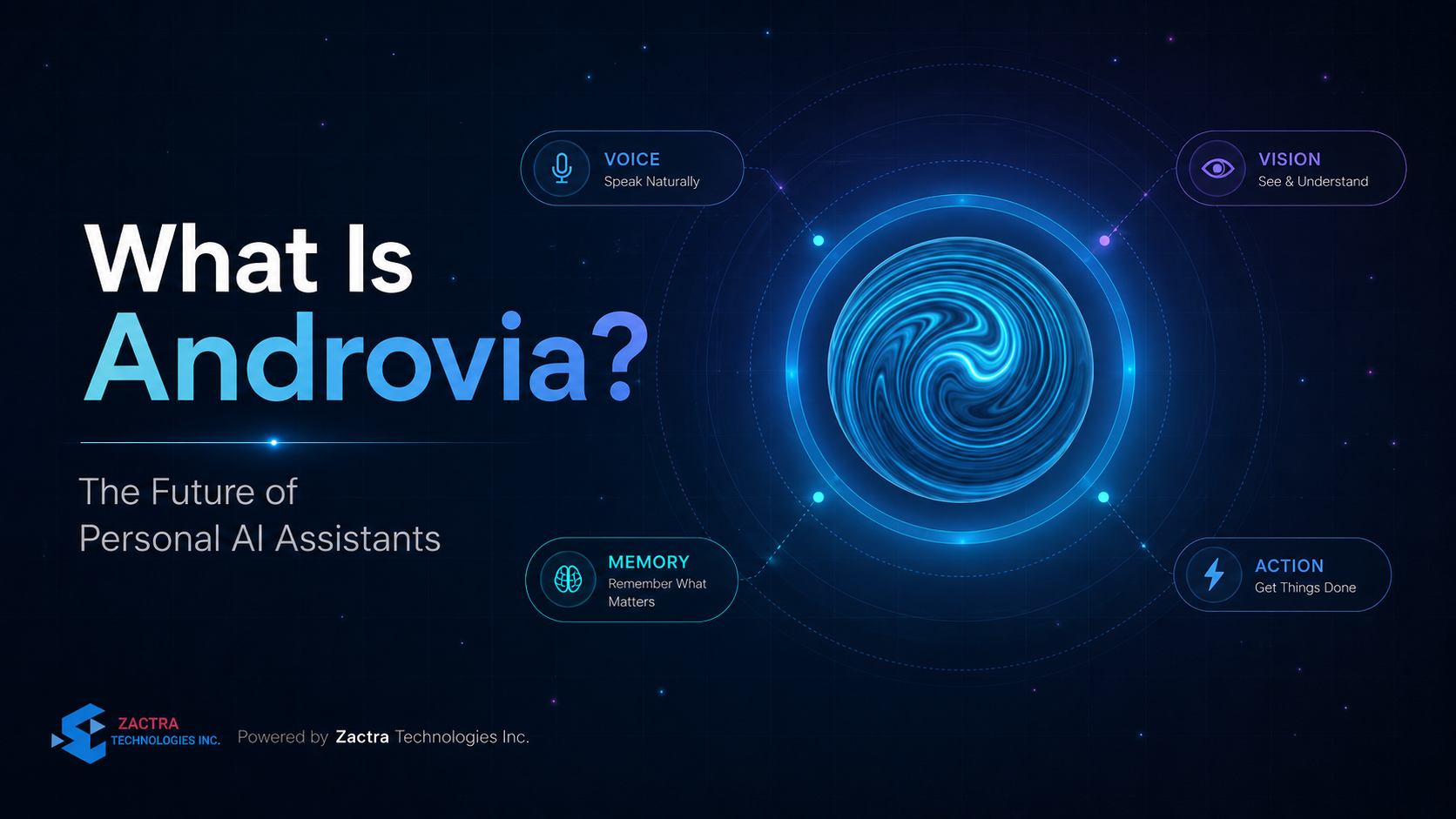
The Next Generation of Personal Intelligence
A Personal AI Assistant That Can Listen, See, Remember, and Take Action
Artificial intelligence is moving beyond the traditional chatbot. The next generation of AI will not simply answer questions—it will understand context, communicate naturally, remember what matters, work across devices, and help people complete real-world tasks. Androvia is being built for that future.
For years, digital assistants have promised to make technology feel more natural. People have used them to set alarms, check the weather, search the internet, play music, and answer basic questions. Yet most assistants still operate as disconnected tools. They respond to one command at a time, forget important context, and often require users to manually move information between applications.
Androvia represents a different approach. It is designed as a real-time, multimodal personal AI assistant that can communicate through voice and text, interpret visual information, maintain useful context, access connected services, and perform authorized actions on behalf of the user.
Instead of functioning only as a question-and-answer interface, Androvia is intended to become an intelligent layer between people, their devices, their information, and the digital services they use every day.
What Is Androvia?
Androvia is a personal AI assistant designed to support natural, continuous interaction across voice, text, vision, memory, connected applications, and compatible devices.
At its core, Androvia combines several technologies that are usually separated into different products. It can process spoken language, understand written requests, analyze camera or screen input, remember relevant information, manage ongoing conversations, and use tools to complete tasks.
In simple terms: Androvia is being developed to move personal AI from “tell me something” toward “understand what I need and help me accomplish it.”
A user might ask Androvia to summarize a document, identify an object through a camera, create a reminder, search for a file, check a calendar conflict, draft an email, provide directions, or continue a conversation that was interrupted moments earlier.
The goal is not to replace every application. Instead, Androvia can act as a unified conversational interface through which users access information and services without repeatedly switching between apps, menus, and devices.
Why Personal AI Assistants Are the Next Major Shift
Most software is still built around interfaces that require people to adapt to machines. Users must learn where information is stored, which buttons to press, how each application works, and how to move data between different services.
Personal AI reverses that relationship. Instead of requiring the user to understand every interface, the assistant attempts to understand the user’s intention.
This shift matters because digital life has become fragmented. A single person may use separate tools for email, meetings, documents, reminders, navigation, shopping, finances, messaging, smart-home devices, and project management. Each service holds only a small part of the user’s context.
A capable personal AI assistant can provide a more connected experience by understanding how these activities relate to one another.
From Commands to Context
Traditional assistants wait for isolated commands. A personal AI assistant can maintain the flow of a conversation, understand references such as “that file” or “the meeting tomorrow,” and connect the current request with relevant information from earlier interactions.
The Four Core Pillars of Androvia
1. Natural Voice and Conversation
Androvia is designed for real-time spoken interaction. Its voice system can convert speech into text, process the user’s intention, generate a response, and return spoken audio. More importantly, the conversation engine is built to handle interruptions, pauses, corrections, continuation requests, and changing topics.
2. Vision and Environmental Understanding
With authorized camera or screen access, Androvia can analyze visual information. This may include identifying objects, reading documents, recognizing QR codes or barcodes, comparing images, examining a screen, and describing what is visible in front of the user.
3. Context and Memory
A useful assistant should not treat every interaction as the first conversation. Androvia includes a structured memory system designed to store relevant facts, preferences, conversation summaries, tasks, reminders, and visual context. Users can also update or remove stored information when required.
4. Real-World Action
Androvia is designed to use connected tools rather than merely describing what a user should do. Depending on available permissions and integrations, it can create reminders, manage tasks, work with files, check schedules, prepare messages, retrieve location information, control connected devices, and interact with external services.
How Androvia Works
Androvia uses a modular architecture in which specialized systems work together. This allows the assistant to process different kinds of input and choose the correct method for completing a request.
1
The user speaks, types, or shares visual input.
2
Androvia interprets the user’s intent and current context.
3
Relevant memory and session information are retrieved.
4
The assistant answers directly or selects an authorized tool.
5
The result is returned through text, voice, or a connected interface.
One important part of this design is the distinction between generating language and performing an action. When a user asks for current weather, a reminder, a location lookup, or another verifiable operation, Androvia can route the request to the appropriate tool rather than inventing an answer.
The system also includes execution controls for permissions, confirmation, timeouts, retries, cancellation, and audit records. These controls are especially important when an AI assistant can affect files, messages, schedules, connected devices, or external accounts.
What Can Androvia Help With?
Real-Time Conversations
Users can communicate with Androvia through text or speech. The assistant is designed to maintain conversational continuity, respond naturally, and recover when the user interrupts or corrects a request.
Reminders, Tasks, and Personal Organization
Androvia can support one-time reminders, recurring schedules, task lists, priorities, categories, updates, snoozing, and completion. A user may say, “Remind me to send the report tomorrow morning,” and the assistant can convert that request into a structured reminder.
Documents and Files
The assistant is designed to locate, open, read, create, rename, move, and edit supported files. This can include PDFs, documents, spreadsheets, presentations, and source-code files, depending on the device and permissions available.
Visual Assistance
Camera and screen analysis can help users understand their environment. Androvia may read visible text, identify an object, analyze a document, scan a code, compare images, or explain what appears on a device screen.
Communication and Scheduling
Through connected services, Androvia can support email drafting, message preparation, contact lookup, calendar checks, meeting creation, invitation management, and schedule conflict detection.
Location, Weather, and Travel
With an approved integration, Androvia can retrieve current location information, provide directions, estimate travel time, identify nearby places, check weather conditions, search travel options, and help organize an itinerary.
Connected Devices and Smart Environments
The platform is designed to work across compatible phones, browsers, computers, smart speakers, cameras, smart glasses, and connected-home systems. The exact functionality depends on the hardware, services, and permissions configured by the user or organization.
A Day With Androvia
In the morning, a user might ask Androvia for a summary of upcoming meetings, important reminders, weather conditions, and travel time to the office.
During work, the user could ask it to find a presentation, summarize a PDF, create a task, check whether a meeting conflicts with another event, and draft a follow-up email.
While travelling, the user could request directions, identify a nearby service, translate visible text, or ask the assistant to remember an important observation.
At the end of the day, Androvia could help review incomplete tasks, organize tomorrow’s priorities, and set recurring reminders. The value comes from continuity—the same assistant remains available across multiple moments instead of disappearing after each isolated command.
Androvia vs. Traditional Digital Assistants
| Capability |
Traditional Assistant |
Androvia’s Approach |
| Conversation |
Single commands and short exchanges |
Continuous, context-aware interaction |
| Input |
Mostly voice or text |
Voice, text, camera, images, and screen input |
| Memory |
Limited or session-based |
Structured memory, preferences, and summaries |
| Actions |
Small predefined command set |
Expandable tools and connected integrations |
| Devices |
Usually tied to one ecosystem |
Designed for multiple devices and interfaces |
| Interruption handling |
Often restarts or loses context |
Designed to resume from what the user already heard |
Who Can Benefit From Androvia?
A personal AI assistant can provide value across many different roles and situations.
- Professionals can manage meetings, documents, tasks, reminders, emails, and daily priorities.
- Entrepreneurs can reduce administrative work and maintain a clearer view of ongoing projects.
- Students can organize deadlines, summarize material, create study plans, and locate academic files.
- Developers can inspect code, search projects, run approved commands, review logs, and support testing workflows.
- Travellers can access directions, local information, weather, itineraries, and visual assistance.
- Users with accessibility needs may benefit from voice-first control, visual descriptions, text reading, and reduced reliance on complex menus.
Privacy, Permissions, and Responsible AI
The more capable an AI assistant becomes, the more important trust becomes. A system that can access files, cameras, messages, calendars, locations, or connected devices must be designed with clear authorization and execution controls.
Androvia’s architecture separates conversational reasoning from tool execution. Actions can be governed through permission checks, confirmation requirements, cancellation controls, time limits, retry policies, and execution records.
Some AI processing can also be hosted on privately controlled infrastructure, depending on the selected deployment. This may give individuals and organizations greater control over where models and data are processed. However, the final privacy level always depends on the complete deployment, including connected services, storage policies, hosting environment, device security, and user permissions.
Responsible personal AI should remain user-controlled. People should be able to understand what the assistant can access, approve sensitive actions, correct stored information, and revoke permissions when necessary.
The Future of Personal AI Assistants
The future of AI is unlikely to be defined by a single chatbot inside a browser tab. Personal AI will increasingly become available through phones, computers, wearable devices, vehicles, cameras, speakers, and other connected environments.
These assistants will become more useful as they improve in five important areas:
- Continuity: remembering enough context to support an ongoing relationship without requiring users to repeat themselves.
- Multimodal understanding: combining language, sound, images, video, location, and device information.
- Action reliability: performing verified tasks safely rather than only generating suggestions.
- Personalization: adapting to the user’s routines, preferences, responsibilities, and communication style.
- User control: providing transparent permissions, privacy choices, and the ability to inspect or remove stored information.
Androvia is being developed around this broader vision: an AI assistant that does not merely wait inside an application but becomes a dependable, context-aware interface for everyday digital life.
Why Androvia Matters
The true value of personal AI is not measured by how many facts it can recite. It is measured by how effectively it helps a person move from intention to outcome.
An assistant becomes genuinely useful when it understands the request, remembers relevant context, chooses the right tool, asks for approval when necessary, and completes the task with minimal friction.
Androvia brings voice, vision, memory, real-time interaction, and action execution together in one extensible system. That combination is what makes it more than a chatbot—and what positions it as part of the future of personal computing.
Frequently Asked Questions
Is Androvia a chatbot?
Androvia includes conversational AI, but it is designed to go beyond a conventional chatbot. It combines conversation with voice processing, visual understanding, memory, connected tools, reminders, files, device interaction, and real-world actions.
Can Androvia understand voice commands?
Yes. Androvia includes a real-time speech pipeline that converts spoken language into text, processes the request, and can return a synthesized voice response.
Can Androvia see through a camera?
With authorized camera access, Androvia can analyze visual input, describe scenes, read visible text, inspect documents, recognize codes, compare images, and support other vision-based tasks.
Does Androvia remember previous conversations?
Androvia includes structured conversation history and memory features. What is stored depends on the configuration, user permissions, and applicable data-retention policies.
Can Androvia perform tasks?
Yes. Through approved tools and integrations, Androvia can perform tasks such as creating reminders, organizing files, checking schedules, preparing messages, retrieving information, and interacting with compatible services.
Can Androvia work across multiple devices?
The platform is designed for multi-device use, including compatible browsers, computers, mobile devices, cameras, smart glasses, speakers, and connected systems. Availability depends on the final client application and device integration.
Is Androvia suitable for businesses?
The architecture can support professional and organizational use cases, particularly where teams need controlled access to documents, schedules, internal services, communication tools, and privately managed AI infrastructure.
Where can I learn more about Androvia?
Final Thoughts
Personal AI assistants are evolving from simple command-based utilities into intelligent systems capable of understanding language, interpreting visual information, maintaining context, and completing authorized tasks.
Androvia is being built for this transition. Its purpose is to create a more natural relationship between people and technology—one in which users can communicate in their own words while the assistant handles the complexity of applications, tools, services, and devices behind the scenes.
The future of personal computing may not begin with opening an application. It may begin with speaking naturally to an assistant that already understands the context, knows which tools are available, and can help transform a request into a completed action.
Discover the Future of Personal AI
Meet Androvia
Explore how voice, vision, memory, and intelligent action can come together in one personal AI experience.
Explore Androvia

 Numan Khan


 E-mail
 Office